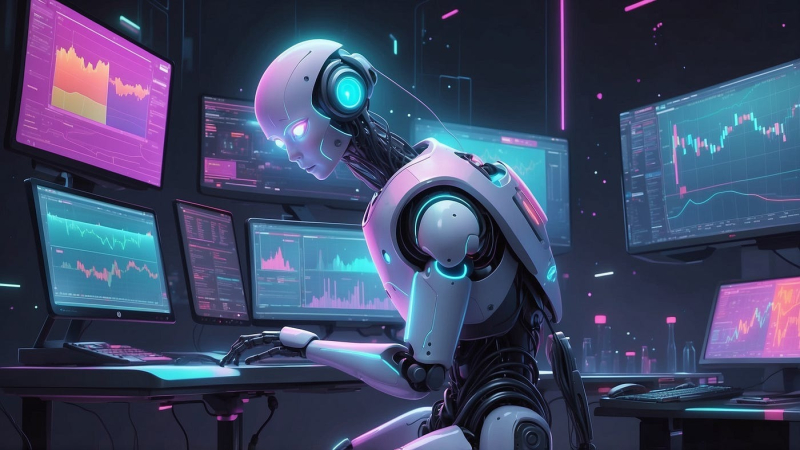
AI driven trading signals have quietly moved from experimental tools into everyday decision making systems across financial markets. What was once limited to quant desks and niche crypto funds is now influencing broader portfolio strategies, including those used by traditionally conservative investors. Algorithms that analyze sentiment, liquidity flows, and multi market correlations are increasingly shaping how positions are entered, adjusted, or exited.
This shift is not happening because artificial intelligence suddenly became more advanced. The real change is trust. Market participants are no longer treating AI outputs as secondary confirmation. Instead, they are beginning to act on these signals earlier in the decision process, sometimes before visible price movement appears on charts.
AI Signals Are Moving Ahead of Price Action
The most important change in AI driven trading is timing. AI systems are now designed to detect subtle market conditions that often appear before prices react. These include shifts in order book depth, changes in derivatives positioning, funding rate behavior, and sentiment patterns across news and social platforms. When combined, these signals offer early insight into where liquidity may move next.
In both crypto and foreign exchange markets, speed matters. AI models process large data sets in real time, allowing traders to react faster than traditional discretionary approaches. This does not guarantee profits, but it improves responsiveness. Instead of reacting to volatility, desks are increasingly positioning in anticipation of it.
This early signal approach is particularly attractive in fragmented markets like crypto, where information travels unevenly and liquidity conditions can change rapidly. AI does not eliminate risk, but it helps identify when risk is shifting.
Confidence Is Replacing Curiosity on Trading Desks
A few years ago, many institutions treated AI as a curiosity or a long term experiment. Today, that mindset has changed. AI systems are being integrated directly into trading workflows, risk dashboards, and portfolio monitoring tools. Traders are no longer asking whether AI should be used. They are asking how much weight its signals deserve.
This confidence has grown alongside improvements in transparency. Modern models often explain which variables are driving a signal, allowing human traders to assess context rather than blindly follow outputs. This combination of machine speed and human judgment is becoming the preferred structure.
As a result, AI is not replacing traders. It is changing how traders think. Decisions that once relied on intuition are now supported by structured probability and pattern recognition.
Shrinking Reaction Time Is Reshaping Strategy
Markets have always rewarded speed, but AI is compressing reaction time further. Signals that once took hours or days to emerge can now be identified within minutes. This has implications for strategy design, particularly for short term and event driven trades.
Faster signals also mean faster invalidation. AI models continuously update as new data enters the system, forcing traders to reassess positions more frequently. This encourages discipline and reduces emotional attachment to trades, especially in volatile environments.
However, faster reaction does not mean constant trading. Many desks use AI to filter noise and avoid unnecessary activity. In this sense, AI can actually reduce overtrading by clarifying when conditions are not favorable.
The Edge Belongs to Signal Interpretation
As AI tools become more common, raw access to technology is no longer the advantage. The edge now lies in interpretation. Firms that understand how to contextualize AI signals within macro conditions, regulatory shifts, and market structure will outperform those that treat signals as isolated triggers.
AI is powerful, but it is not infallible. Models reflect the data they are trained on and can struggle during regime changes. This makes human oversight essential. The most effective teams use AI as an early warning system rather than a final authority.
Markets are listening to AI, but they are not surrendering control to it. The relationship is collaborative, not hierarchical.
Conclusion
AI traders are getting louder because their signals are arriving earlier, clearer, and with growing credibility. Markets are responding not because AI is new, but because it is now trusted as a meaningful input. The future of trading will belong to those who can hear these signals early, understand them properly, and act with discipline rather than haste.