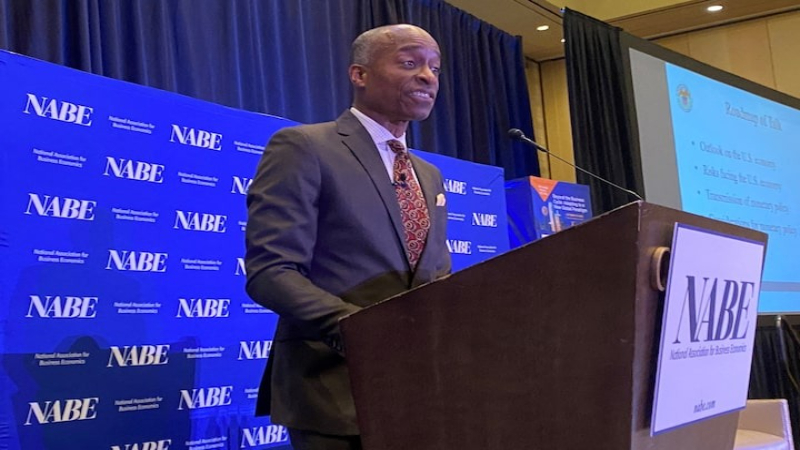
Federal Reserve Vice Chair Philip Jefferson sent a strong signal through markets today after saying the explosive rise in AI linked stocks is unlikely to mirror the dot com bubble that collapsed in the late nineties, reinforcing the view that the current tech surge is built on firmer ground. Jefferson said the key difference is that today’s leading AI firms are not speculative experiments but established companies producing real revenue and earnings, giving the sector a fundamentally stronger base than the early internet boom. His comments arrive as enthusiasm around AI intensifies and as a recent Fed survey shows that thirty percent of financial professionals see a sudden reversal in AI sentiment as a major risk to the US economy. Jefferson emphasized that the financial backdrop is sound and resilient, suggesting the system is better positioned to absorb tech volatility than it was during the dot com era when leverage and speculative valuations were rampant. His remarks echo the sentiment across markets that the AI wave is powerful but not yet detached from fundamentals, even as concerns grow around overextension in parts of the sector.
Jefferson also highlighted that unlike the dot com period, most AI oriented companies have not leaned heavily on debt to fuel their growth. This low leverage profile acts as a buffer against systemic spillover because it limits how much damage a sudden shift in risk appetite could transmit through credit markets. Analysts expect that as AI infrastructure spending ramps up through data centers, specialized chips and compute power, some companies may eventually increase borrowing, but Jefferson said he is watching that trend closely. He cautioned that if sentiment toward AI shifted abruptly while debt loads were high, losses could intensify across the tech ecosystem. His message effectively serves as a reminder that AI’s long term impact will likely unfold in waves and may be unpredictable, with real implications for labor markets, inflation dynamics and the broader path of monetary policy. As markets digest his perspective, traders say his tone strikes a balance between recognizing AI’s transformative potential and acknowledging the risks that come with any disruptive technology cycle.
His comments land at a time when volatility around tech stocks is already running high and when markets are trying to determine whether the AI surge has reached a point where expectations are running ahead of actual returns. Jefferson pointed to the resilience of the current financial system as a sign that even a cooling in AI sentiment would not automatically trigger broad instability, countering fears of a systemic replay of past tech crashes. Still he acknowledged that AI adoption may reshape the economic landscape in ways that are not yet clear, and that the transition could be uneven as businesses reorganize around new capabilities. For traders the statements add another layer to the macro narrative heading into the final weeks of the year where technology, interest rate expectations and market psychology are tightly intertwined. Whether the AI sector cools or accelerates next will depend on how strongly earnings continue to support valuations, but the Fed’s view that this cycle is structurally different from the dot com boom is likely to influence sentiment in both equity and credit markets.