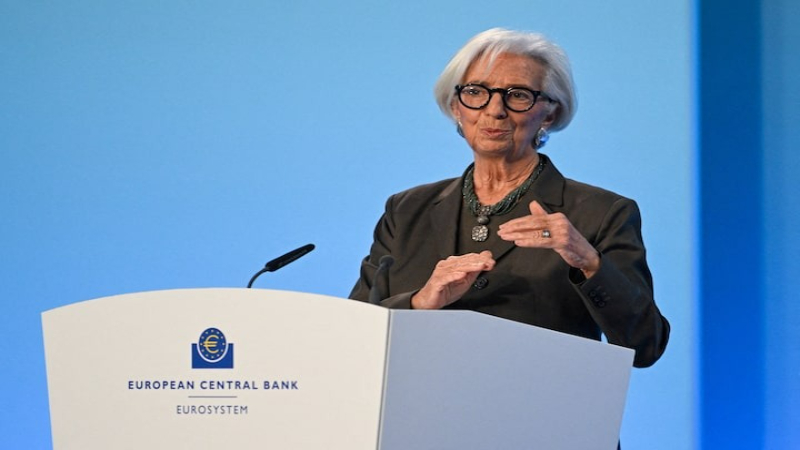
Euro zone inflation is expected to stabilise at the European Central Bank’s 2% target over the medium term, even after dipping below that level earlier this year, according to remarks from Christine Lagarde. Speaking to European lawmakers on February 9, Lagarde said the ECB’s latest assessment supports its view that price stability remains achievable, though the broader economic environment continues to present significant uncertainty.
Lagarde told legislators that recent data reinforce the central bank’s confidence in its inflation outlook. While headline inflation has eased faster than many expected, she stressed that this development does not undermine the ECB’s longer term objective. Instead, it reflects the gradual unwinding of earlier price pressures linked to energy costs, supply chain disruptions, and post pandemic demand imbalances.
Despite the improving inflation picture, Lagarde cautioned against complacency. She highlighted that the euro area economy is navigating an unusually complex mix of forces, including geopolitical tensions, shifting global trade patterns, and uneven growth across member states. These factors, she said, make it essential for policymakers to retain flexibility rather than commit to a predetermined policy path.
The ECB’s approach remains firmly data dependent, with decisions taken on a meeting by meeting basis. Lagarde emphasized that interest rate choices will continue to be guided by incoming economic indicators, inflation dynamics, and the transmission of monetary policy across the euro zone. This stance reflects the bank’s effort to balance the risk of easing too quickly against the danger of keeping conditions overly restrictive for too long.
Markets have been closely watching ECB communications for clues on the timing and pace of potential rate cuts. With inflation now closer to target and economic growth showing signs of strain in parts of the bloc, investors have increasingly priced in expectations of gradual policy easing later this year. Lagarde did not validate or reject those expectations, instead reiterating that the governing council will respond only to confirmed trends rather than forecasts alone.
She also pointed to underlying inflation measures as a key focus. While headline inflation can be volatile, especially due to energy and food prices, core indicators provide a clearer picture of domestic price pressures. Progress in these areas, Lagarde suggested, is encouraging but still requires careful monitoring, particularly in relation to wage growth and services inflation.
The ECB president acknowledged that uncertainty remains elevated compared with pre pandemic norms. Global financial conditions, fiscal policy decisions by member states, and developments in major economies outside the euro area all have the potential to influence the inflation path. As a result, the central bank is wary of sending signals that could be misinterpreted as firm commitments.
For policymakers, the challenge lies in guiding inflation back to target without undermining economic stability. Lagarde’s comments signal confidence that the ECB’s strategy is working, while also underscoring the need for patience and vigilance. The message to markets and governments alike is that while the destination is clearer, the path toward stable prices still requires careful navigation.