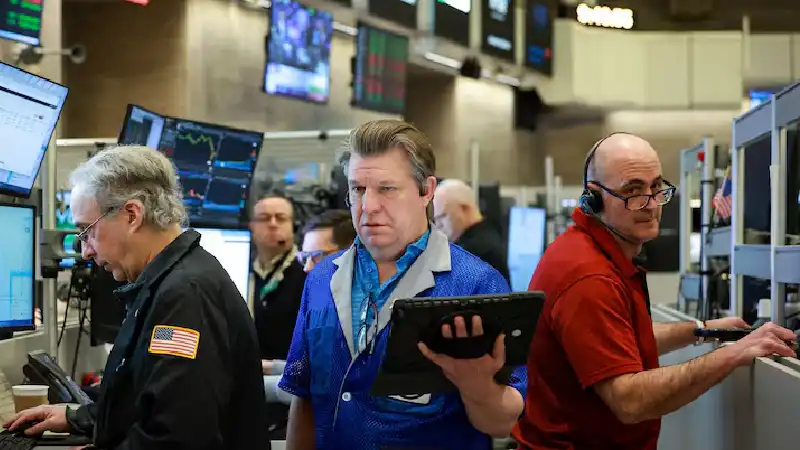
Wall Street’s major indexes rallied on Monday following U.S. President Donald Trump’s announcement that military strikes against Iranian power plants and energy infrastructure were postponed after “productive conversations” with Tehran. Global markets responded with renewed risk appetite as Europe’s STOXX 600 and precious metals edged higher, while oil prices fell sharply. Investors interpreted the development as easing geopolitical tensions that had previously pressured equities, with the Dow Jones Industrial Average rising 1.66 percent to 46,336.25, the S&P 500 gaining 1.52 percent to 6,605.26, and the Nasdaq Composite climbing 1.77 percent to 22,033.90. The small-cap Russell 2000 surged 2.26 percent amid the relief rally.
Energy markets reacted notably, with oil prices plunging more than seven percent after the news. Despite broader market gains, major energy companies posted declines, with Exxon Mobil down 1.2 percent, Chevron falling 0.6 percent, and Occidental Petroleum retreating 1.6 percent. The S&P 500 energy index edged lower by 0.3 percent. Conversely, airlines and cruise operators soared, reflecting optimism about reduced geopolitical risk. American Airlines and United Airlines jumped over 4.5 percent, while Carnival, Norwegian Cruise Lines, and Viking Holdings all rose more than 5.5 percent. Consumer discretionary stocks also advanced, gaining roughly 3 percent as investors rotated into growth sectors.
Banks rebounded after earlier sell-offs during the Middle East conflict, with JPMorgan Chase and Goldman Sachs both adding around 2 percent. The S&P 500 banking index climbed 1.5 percent as investors anticipated stabilization in global markets. Advancing issues outnumbered decliners by 4.69-to-1 on the NYSE and 3.39-to-1 on the Nasdaq, while the Nasdaq recorded 11 new highs and 60 new lows, signaling a mixed but broadly positive market sentiment. Investor attention is expected to focus on Fed speakers, business activity surveys, and consumer sentiment data later this week.
The CBOE Volatility Index, Wall Street’s measure of market fear, retreated to 24.75, down 2.03 points from its recent two-week high, indicating reduced market stress. The relief rally also coincided with investors trimming bets on U.S. Federal Reserve interest-rate hikes, with the probability of a rate cut in December now standing at 24 percent, compared with over 50 percent prior to the Fed’s hawkish tone last week. Market participants remain cautious, noting that the recovery depends on tangible developments in geopolitical tensions.
Individual stock movements highlighted targeted investor interest, with Synopsys surging 4 percent after activist investor Elliott Investment Management disclosed a multibillion-dollar stake in the electronic design automation firm. Overall, the market’s response underscores the influence of geopolitical headlines on investor behavior, with oil prices, energy sector dynamics, and policy expectations driving near-term market volatility and sector rotation across equities.