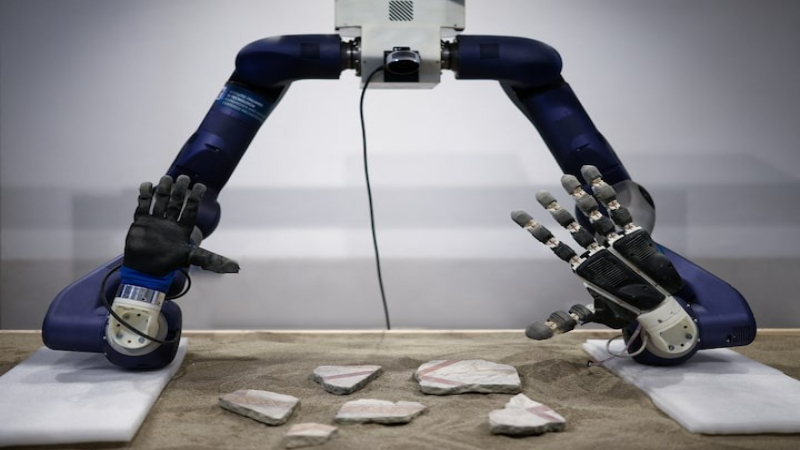
A new robotic system tested in Pompeii is turning global heads after demonstrating how advanced AI can reconstruct ancient artworks shattered nearly two thousand years ago. The technology, built under a European project called RePAIR, uses high precision robotic hands, vision sensors and puzzle solving algorithms to identify, sort and assemble fresco fragments that have been scattered, damaged or buried since the eruption of Mount Vesuvius in AD 79. Researchers say the robot is able to scan surface textures, match microscopic patterns and evaluate fits faster than any human team, transforming a restoration process that normally takes years into something dramatically more efficient. Archaeologists testing the system at Pompeii compared the task to solving several massive jigsaw puzzles at once, except with missing pieces and no reference image. With the robot handling delicate lifting and alignment, restoration crews are able to focus on verification and interpretation rather than the slow mechanical labor that usually dominates the workflow. Tests so far have used replicas of damaged ceiling paintings and frescoes from sites destroyed both by the original eruption and later by bombing during World War Two, giving the team a risk free path to assess accuracy and handling.
The robotics platform uses twin articulated arms with flexible hands in two sizes to grip and maneuver fragments without scratching or stressing the material. AI systems running behind the scenes evaluate shapes, edges, color traces and historical painting techniques to predict how fragments connect even when weathering has blurred or erased patterns. The project began in 2021 and is coordinated by Ca’ Foscari University in Venice, bringing together engineers, archaeologists and machine learning specialists from multiple countries. Scientists believe this technology will eventually scale far beyond Pompeii, offering a toolkit capable of assisting museums and restoration labs around the world with complex reconstructions. Sites with long term storage rooms full of fragmented artifacts could rely on similar systems to unlock pieces that have been untouched for decades because the manual labor demands were too high. Experts involved in the testing describe the system as a breakthrough moment that blends robotics with cultural heritage science, opening a path toward digital era restoration techniques that preserve fragile history with unprecedented accuracy.
Beyond the archaeological impact, the project sends a broader signal about how AI driven physical systems are evolving. The robot’s ability to use visual reasoning and precision handling mirrors broader advances in AI assisted manufacturing and automated assembly environments. Researchers say the same foundations used here could eventually adapt to industrial scenarios requiring delicate manipulation or complex pattern recognition. For now, archaeologists working in Pompeii say the robot changes how they imagine the future of restoration, especially for sites where centuries of damage have left vast catalogs of unassembled material. By reducing the physical risks of handling and speeding up the search for potential matches, AI becomes not just a research tool but a practical collaborator. As the system continues training, teams expect accuracy to improve further, giving museums and excavation sites a new digital ally in reconstructing global heritage. The Pompeii trial marks a symbolic moment where ancient history and cutting edge AI meet, hinting at how restoration work may evolve across the coming decade.