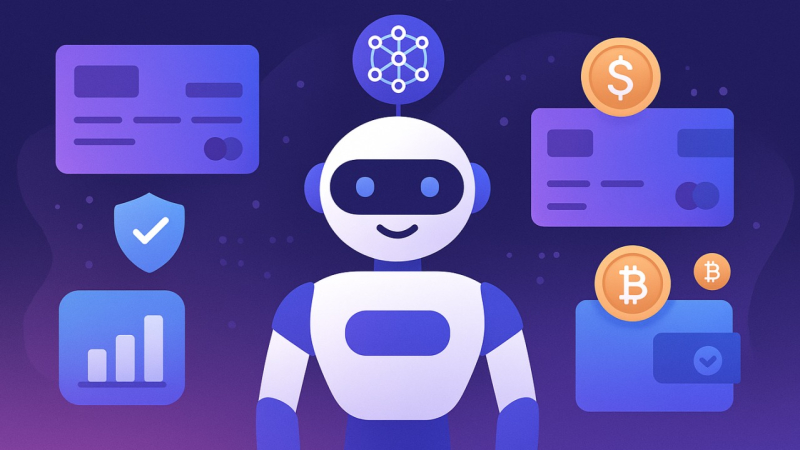
Finance has always been built around interfaces. Apps, dashboards, and platforms exist so humans can tell systems what to do. That model is starting to crack. As AI agents become more capable and token based money becomes more programmable, finance is shifting away from app driven interaction and toward autonomous execution.
This change is not about better apps. It is about removing the app layer altogether for certain decisions. When AI agents can hold, move, and deploy tokenized money on their own, finance becomes something that runs continuously in the background. Humans set objectives. Systems execute. That shift has deep implications for markets, infrastructure, and how risk is managed.
Why AI Agents Change the Role of Money
Traditional money assumes a human decision maker. You log in, approve a transaction, and confirm intent. AI agents break that assumption. They operate continuously, reacting to conditions rather than instructions.
Token money makes this possible. Unlike traditional accounts, tokenized money can be programmed with rules. It can move automatically when conditions are met. This allows AI agents to act directly in financial systems without constant supervision.
The result is money that responds to logic instead of clicks. That is a fundamental change in how financial activity is initiated.
From User Interfaces to Objective Based Systems
Apps are built around choice. Buttons, menus, and confirmations exist to capture human intent. Autonomous finance flips that model.
In an agent driven system, the user defines goals. Preserve liquidity. Minimize funding cost. Rebalance exposure within limits. The AI agent monitors conditions and acts when criteria are satisfied.
There is no need to open an app for every decision. Execution happens continuously. This reduces latency and removes emotional bias from routine actions.
The interface becomes the objective, not the transaction.
Token Money Enables Machine Native Settlement
AI agents need money that behaves like software. Token money provides that behavior.
Tokenized assets can be transferred instantly, settled atomically, and governed by smart rules. An AI agent can pay, hedge, lend, or rebalance without waiting for human approval.
This machine native settlement allows agent to agent interaction. One AI system can transact with another directly, negotiating terms and settling value automatically.
This is not speculative. It is a logical extension of programmable assets interacting with autonomous decision makers.
Markets Become More Continuous and Less Event Driven
When AI agents manage capital autonomously, markets change character. Activity becomes smoother and more continuous.
Instead of large bursts around human decision points, capital adjusts incrementally. Risk is managed constantly rather than periodically.
This reduces some forms of volatility while introducing new dynamics. Small signals matter more. Micro conditions trigger responses. The market becomes more sensitive but less emotional.
Price moves reflect system behavior rather than collective sentiment alone.
Risk Shifts From Execution to Design
In autonomous finance, the main risk is no longer execution error. It is design error.
If an AI agent’s objectives or constraints are poorly defined, it can act in unintended ways. Token money will do exactly what it is told.
This shifts responsibility upstream. Governance, testing, and oversight matter more than speed. Systems must be designed with clear limits, fallback conditions, and accountability.
The challenge is not trusting AI to execute. It is trusting humans to define the right rules.
Why Institutions Are Paying Attention
Institutions see autonomous finance as an efficiency gain rather than a novelty. Treasury management, collateral optimization, and liquidity allocation are repetitive tasks that AI agents handle well.
Token money allows these agents to operate within controlled environments. Rules can enforce compliance and risk limits automatically.
This appeals to institutions that want automation without chaos. Autonomous does not mean uncontrolled. It means consistently enforced logic.
Why This Is Bigger Than Crypto Apps
This shift is not about replacing wallets or exchanges. It is about changing how financial decisions are made.
Apps are episodic. Autonomous finance is continuous. Apps require attention. Autonomous systems require oversight.
As this model spreads, finance becomes less visible but more responsive. The background hum replaces the click.
What This Means for Users and Markets
For users, finance becomes less manual. For markets, it becomes more structured.
Liquidity adjusts faster. Arbitrage tightens. Risk is redistributed dynamically.
The winners are those who design good objectives and robust constraints. The losers are those who rely on slow reaction and manual control.
What to Watch Going Forward
Watch where AI agents are allowed to hold and move real value. Watch where tokenized money integrates with automated decision systems.
Also watch governance frameworks. Autonomous finance only scales where accountability is clear.
The shift will be gradual, but once it starts, it compounds.
Conclusion
AI agents and token money are pushing finance beyond apps and into autonomous systems. Money becomes programmable. Decisions become continuous. Execution becomes automatic. This shift does not remove humans from finance. It moves them upstream into design, oversight, and intent. The future of finance runs quietly in the background, guided by objectives rather than interfaces.