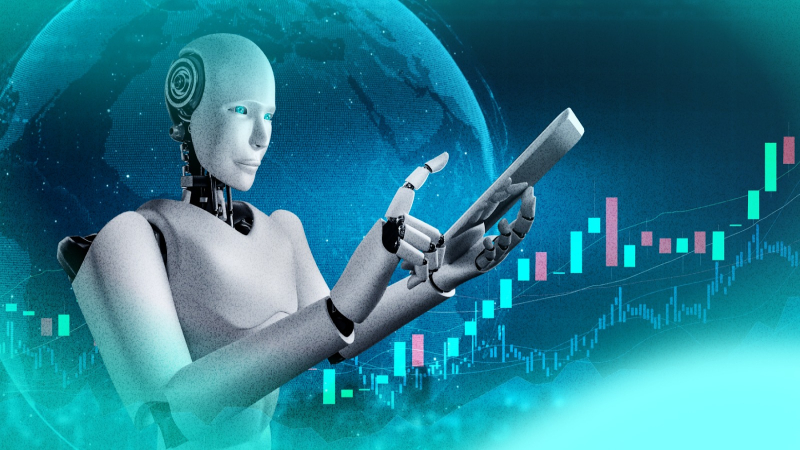
Financial markets have long been shaped by human judgment, instinct, and reaction. Fear, optimism, and momentum once dictated how prices moved and how capital flowed. Today, that dynamic is changing quietly but decisively. Artificial intelligence is no longer just another analytical tool sitting beside traders. It has begun reshaping how markets learn, adapt, and internalize behavior.
Rather than executing trades at scale, AI systems now influence how institutions interpret information, assess risk, and prepare for uncertainty. The result is not a market driven by machines pressing buy and sell buttons, but one that is continuously being conditioned. Markets are still human, but their responses are increasingly shaped by models that learn faster than people do.
The market is learning from machines
The most important contribution of AI to markets is feedback, not speed. Modern AI systems absorb vast amounts of macroeconomic data, liquidity signals, volatility metrics, and sentiment indicators. These insights feed directly into institutional decision frameworks that govern portfolio construction, risk limits, and capital allocation.
Over time, this feedback loop reshapes behavior. When models repeatedly highlight where risk is mispriced or liquidity is thin, institutions adjust positioning in advance. The market evolves based on what algorithms have learned rather than what traders feel. AI is not replacing decision makers, but it is training the environment in which decisions are made.
Markets respond to incentives. When AI driven insights influence those incentives, the entire structure adapts. This is how AI trains the market without directly trading it.
Why prediction matters more than execution
AI excels at probabilistic thinking rather than directional certainty. Instead of forecasting a single outcome, models assign likelihoods to a range of scenarios. This approach now underpins risk management, hedging strategies, and capital deployment across traditional and digital markets.
As more institutions adopt similar modeling logic, reactions become more uniform. Volatility often compresses because risks are anticipated earlier. Correlations increase because participants are responding to similar signals. The market appears stable, but that stability is engineered rather than organic.
This is not a flaw in AI. It is a structural consequence. When prediction frameworks converge, execution becomes secondary. Markets move less on surprise and more on gradual repositioning that only becomes visible after it has already occurred.
Crypto markets reveal the shift first
Crypto markets offer a clear view of this transformation because of their transparency and continuous data flow. AI driven analytics monitor wallet activity, derivatives positioning, network usage, and liquidity depth in real time. These signals influence institutional behavior long before price action reflects it.
As a result, crypto prices increasingly respond to anticipated behavior rather than reactive speculation. Large moves often follow positioning changes that happened quietly. This reinforces the idea that AI is shaping expectations first and prices second.
Crypto markets are not leading this shift because they are riskier, but because they are structurally easier to analyze. What appears here eventually migrates into broader financial markets.
The risk of homogenous intelligence
A growing concern is convergence. As institutions rely on similar datasets and modeling frameworks, diversity of thought narrows. When assumptions are shared, mispricing can persist longer and unwind faster.
AI does not remove uncertainty. It redistributes it. Risk becomes embedded in correlations, assumptions, and model dependencies rather than visible sentiment. When conditions change in ways models did not anticipate, markets can react abruptly.
Training the market creates efficiency, but it also introduces blind spots. Understanding those blind spots is becoming as important as understanding the models themselves.
What this means for the future of markets
Markets shaped by AI are not less human, but they are less emotional on the surface. Behavior becomes more structured. Reactions become more calculated. Surprises become fewer, but when they occur, they are more concentrated.
Success increasingly depends on understanding how signals are formed rather than simply reacting to price movements. AI is not eliminating judgment. It is defining the boundaries within which judgment operates.
Conclusion
AI has moved beyond trading activity into shaping how markets think, price risk, and respond to change. The future of finance will be influenced less by individual trades and more by the systems that train collective behavior. Understanding that shift is no longer optional. It is becoming a requirement for navigating modern markets.