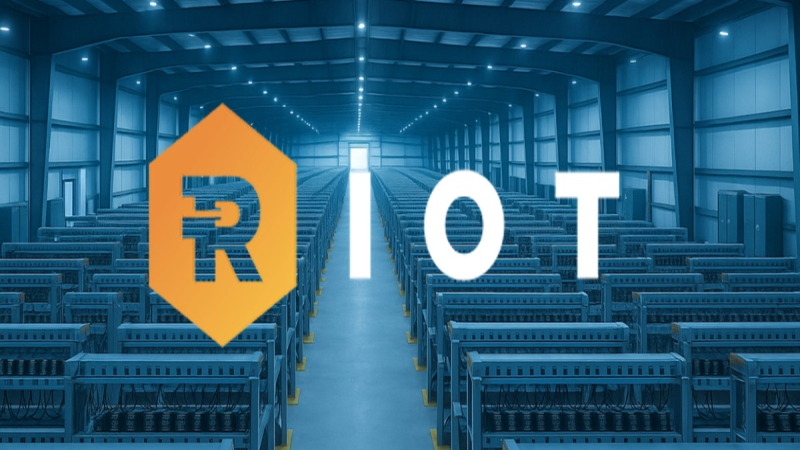
Riot Platforms shares climbed sharply on January 16 after the bitcoin mining firm confirmed a significant strategic shift toward artificial intelligence infrastructure, underscoring how miners are increasingly repositioning to capture demand beyond crypto validation. The rally followed confirmation that the company finalized ownership of its Rockdale site in Texas and secured a long-term data center leasing agreement with a major semiconductor firm. Investors responded positively to the clarity around Riot’s diversification strategy, viewing the move as a way to stabilize revenues amid volatile bitcoin prices. The development highlights how access to power and land, once optimized for mining, is now being repurposed to serve high-growth compute markets tied to AI workloads.
The Rockdale transaction involved a $96 million land acquisition funded entirely through the sale of bitcoin held on Riot’s balance sheet, reflecting an active capital reallocation rather than reliance on external financing. By converting digital assets into fixed infrastructure, the company signaled confidence in long-term demand for data center capacity in Texas, a region benefiting from power availability and proximity to major urban hubs. The land acquisition grants Riot direct control over a key site central to its operational footprint, reducing long-term uncertainty around leasing and allowing for flexible infrastructure development. Market participants viewed the balance sheet decision as disciplined capital management rather than a bearish signal on bitcoin exposure.
Alongside the land purchase, Riot entered into a long-duration data center lease that marks its first hyperscale tenant agreement. The initial phase covers 25 megawatts of critical IT load, with delivery scheduled in stages through mid-2026 using existing structures retrofitted for advanced computing. The contract spans a decade and is expected to generate hundreds of millions of dollars in revenue over its base term, with additional options that could significantly expand total contract value. This structure provides predictable cash flows while preserving optionality for further expansion as AI infrastructure demand continues to scale.
The announcement reinforced a broader trend across the mining sector, where firms are leveraging power capacity and physical assets to diversify beyond block rewards. Riot’s Texas facilities collectively control substantial acreage and energy access, positioning the company as a hybrid digital infrastructure operator rather than a pure-play miner. The market reaction suggests investors are increasingly rewarding miners that adapt to structural shifts in compute demand. As AI-related capital expenditure accelerates globally, Riot’s pivot reflects how crypto-native firms are seeking relevance and resilience within a rapidly evolving technology and energy landscape.