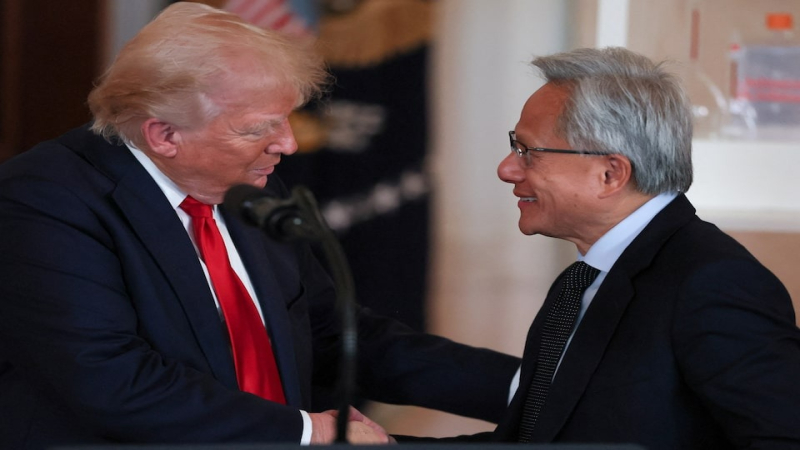
A new wave of market chatter surged today after reports surfaced that President Donald Trump held a private meeting with Nvidia CEO Jensen Huang to discuss export controls on advanced chips. The update instantly caught the attention of investors who have been tracking the global compression in AI hardware supply, with Nvidia’s products at the center of nearly every compute driven expansion cycle. Traders noted that any conversation between the White House and the world’s most influential chip executive can send ripples through everything from cloud infrastructure costs to digital asset valuations. The AI sector relies heavily on high performance chips to support the explosive demand for model training, tokenization pipelines and real time computation. News of the meeting circulated quickly across financial platforms as analysts evaluated whether ongoing restrictions could tighten further or whether adjustments might be made to accelerate domestic innovation. With markets already stretched from elevated demand for high bandwidth processors, the update added a fresh layer of volatility to an already sensitive sector as investors monitored sentiment shifts in tech indexes.
The timing of the meeting has also intensified speculation about how export policy adjustments could influence the broader digital economy. Nvidia remains the dominant supplier of compute engines powering AI platforms, decentralized systems and large scale verification models that underpin new tokenization frameworks. Any changes to export rules can dramatically influence build timelines for companies operating in North America, Europe and Asia, especially those relying on steady access to top tier chips. Analysts highlighted that export controls have been a pivotal factor shaping global supply chains during the past two years as chipmakers contend with overwhelming demand for training hardware. Market watchers interpreted the Trump Huang conversation as a signal that policymakers might be preparing to revisit certain thresholds, potentially aiming to balance national security concerns with economic competitiveness. Traders linked to crypto and tokenization desks reacted quickly because chip availability directly affects the speed and cost of running AI enhanced blockchain systems, which have become increasingly important in digital finance scaling.
The broader political undertone around the meeting adds another set of signals for markets attempting to gauge how Washington intends to manage its role in the AI race. As countries like China and South Korea ramp their investment into next generation chip design, the United States faces pressure to maintain leadership across compute heavy industries. Nvidia’s influence extends beyond traditional tech because its hardware has become essential infrastructure for sectors including algorithmic trading, on chain analytics, synthetic asset markets and decentralized compute networks. Investors noted that even the mention of a high level discussion can shift trading patterns as portfolios adjust to potential regulatory or supply shocks. The fact that the meeting was revealed through a reporter’s post pushed the story into rapid circulation across social feeds where traders evaluated potential scenarios. With AI remaining one of the strongest performance drivers in markets this year, any hint of policy movement involving Nvidia has become a catalyst for heightened attention. Market participants now wait to see whether follow up statements will clarify the trajectory of export rules as the global race for compute power intensifies.