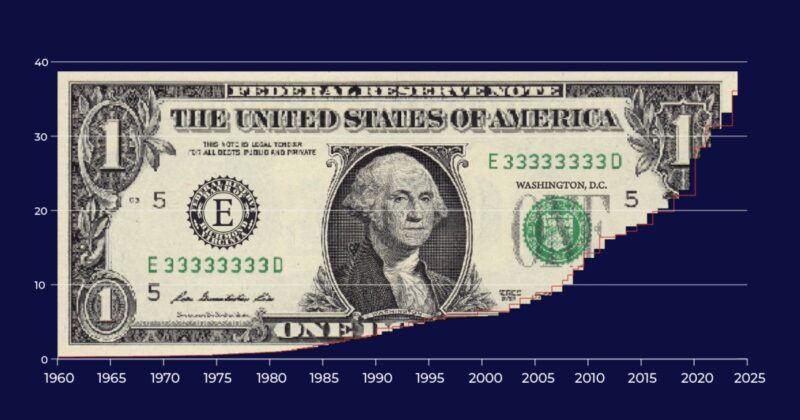
The United States has officially surpassed 36 trillion dollars in federal debt, marking a new era for the world’s largest economy. This staggering figure is more than just a headline; it reflects a fundamental shift in how the U.S. manages its fiscal priorities and how the global market perceives the strength of the dollar. For investors and policymakers, this milestone raises pressing questions about debt sustainability, market confidence, and the future role of the dollar as a global anchor.
While the U.S. economy remains resilient, the rising cost of servicing debt and maintaining investor demand presents a complex balancing act that could shape financial markets well into the next decade.
Fiscal Deficit and Debt Build Up
America’s debt challenge has been decades in the making. Persistent budget deficits driven by entitlement spending, tax cuts, and stimulus measures have pushed borrowing to historic highs. Even with steady economic growth, the gap between federal revenues and expenditures continues to widen, ensuring that debt accumulation remains a structural feature of the U.S. economy.
In fiscal 2025, the government’s annual deficit once again exceeded 1.5 trillion dollars, with interest payments becoming one of the fastest-growing components of federal spending. Higher rates have made servicing costs increasingly burdensome, reducing the space for public investment. For the first time, interest expenses are now comparable in scale to national defense, underscoring how rising debt is crowding out critical priorities.
The concern among analysts is not only the size of the debt but also its upward trajectory. With the debt-to-GDP ratio hovering near 125 percent, the U.S. faces growing scrutiny from global investors who have long viewed Treasuries as the cornerstone of safety. Sustaining that trust will depend on whether fiscal discipline and policy clarity improve in the years ahead.
Political divisions over spending and borrowing limits have only added to uncertainty. Each disagreement between Congress and the Treasury risks creating short-term market stress, making investors more cautious about the reliability of U.S. fiscal management.
Auctions and Investor Sentiment
The Treasury market remains the foundation of global finance, offering liquidity and pricing benchmarks for nearly every asset class. However, the rapid increase in government borrowing is now testing the strength of investor demand. Frequent, large-scale auctions are pushing yields higher as the market works to absorb record levels of new issuance.
Recent auctions have generally cleared successfully, but only after offering more attractive yields. Domestic institutions, including pension funds and money market funds, remain consistent buyers, while foreign demand has become less predictable. Some international investors are gradually reducing their exposure to Treasuries in favor of gold or higher-yielding sovereign bonds.
This change reflects a subtle shift in sentiment. Investors still view the dollar and Treasuries as reliable, but the cushion of confidence is not as deep as before. If yields keep rising to balance supply and demand, bond prices could weaken further, creating ripple effects across portfolios and global liquidity.
Maintaining confidence now depends on clear communication and predictable policy. The Treasury’s ability to manage issuance and the Federal Reserve’s stance on rates will determine whether markets view U.S. debt as stable or stretched. Mixed signals could easily translate into renewed volatility for the dollar.
Dollar Stability Under Pressure
Despite fiscal strain, the dollar continues to benefit from its position as the world’s reserve currency. Its liquidity, rule of law, and market depth still make it the preferred medium for trade and reserves. Yet, the growing scale of U.S. borrowing is starting to challenge that foundation.
Rising yields, while attractive to investors, also signal risk. The higher cost of financing can weigh on growth and create inflationary concerns, which in turn may erode the dollar’s purchasing power. If deficits remain large and inflation pressures reappear, global investors could begin demanding higher compensation for holding dollar assets.
At the same time, diversification among central banks is gaining pace. Several reserve managers have been adding gold and non-dollar assets to their portfolios to reduce concentration risk. Although these moves are gradual, they reflect a broader trend toward balance rather than dependence. The dollar’s leading role remains secure for now, but the pressure to justify that status grows each year.
Investor Outlook and Policy Path
The future of dollar stability will depend heavily on how fiscal and monetary policies interact. If growth slows while debt continues to rise, the market narrative could shift from confidence to concern. That shift would likely increase volatility in Treasury markets and strengthen demand for alternative safe assets.
To maintain credibility, U.S. policymakers must prioritize clarity and coordination. Transparent fiscal planning, disciplined spending, and predictable borrowing schedules will all be essential in preserving global confidence. Political disputes or unclear communication could undermine that effort and heighten market stress.
For investors, the environment remains one of relative strength but narrowing comfort. Understanding how U.S. fiscal management interacts with the broader economy is now a key factor in portfolio strategy. Markets will be quick to react to any perception of fiscal complacency or inflation risk in the months ahead.
Conclusion
Crossing the 36 trillion dollar mark is more than a symbolic milestone. It represents a turning point for fiscal management and dollar stability. The outcome will depend on whether the U.S. can balance borrowing with credibility and maintain the trust that has long supported its global leadership.