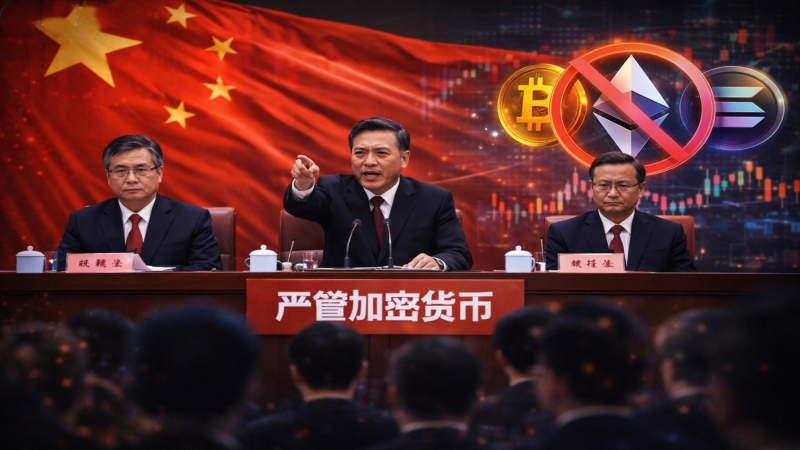
Chinese regulators have widened their long-standing crackdown on cryptocurrencies, extending strict controls to stablecoins and the tokenization of real-world assets as part of a renewed push to protect monetary sovereignty and financial stability.
In a joint notice released late Friday, eight national authorities including the People’s Bank of China and the China Securities Regulatory Commission reaffirmed China’s 2021 ban on cryptocurrency trading and issuance while introducing new oversight measures aimed at emerging blockchain-based financial activity.
The notice said speculative behavior linked to virtual currencies and asset tokenization has increased in recent months, creating new risks for regulators tasked with maintaining financial order. Officials stressed that activities involving cryptocurrencies such as bitcoin, ether and fiat-pegged stablecoins remain illegal, whether conducted domestically or through cross-border channels.
Authorities emphasized that the ban applies not only to local platforms and investors but also to foreign entities and individuals offering crypto-related services inside China. Domestic firms are also prohibited from issuing or facilitating digital currency products overseas without explicit regulatory approval.
Stablecoins received particular attention in the new guidance. Regulators argued that fiat-linked tokens replicate key functions of sovereign money and therefore pose a direct challenge to state control over currency issuance and monetary policy. As a result, no organization will be permitted to issue a stablecoin linked to the renminbi outside China without authorization, including overseas subsidiaries of Chinese companies.
The notice also tightened restrictions on asset tokenization, a rapidly growing practice that converts ownership of assets such as equities, real estate or investment funds into blockchain-based tokens. While limited pilot programs may still be allowed under strict supervision, Chinese firms seeking to tokenize assets abroad must now obtain approvals or file disclosures with regulators. Their financial and technology partners will also be subject to enhanced compliance and reporting requirements.
China’s position builds on a series of past enforcement actions that have shaped its hardline approach to crypto. Authorities banned initial coin offerings in 2017, labeling them illegal fundraising activities, and followed up in 2021 by declaring all crypto-related business operations unlawful and forcing domestic mining operations to shut down.
Despite periodic debate over whether China has softened its stance, the latest move signals renewed determination to keep crypto markets, stablecoins and tokenized finance firmly outside the country’s formal financial system. Analysts say the policy underscores Beijing’s preference for tightly controlled digital finance initiatives, such as central bank digital currency experiments, rather than privately issued blockchain assets.
The expanded rules are expected to increase scrutiny of Chinese-linked crypto and tokenization projects operating overseas and may further chill cross-border experimentation involving yuan-linked digital assets. For global markets, the announcement reinforces China’s role as one of the most restrictive major jurisdictions when it comes to decentralized finance and privately issued digital money.