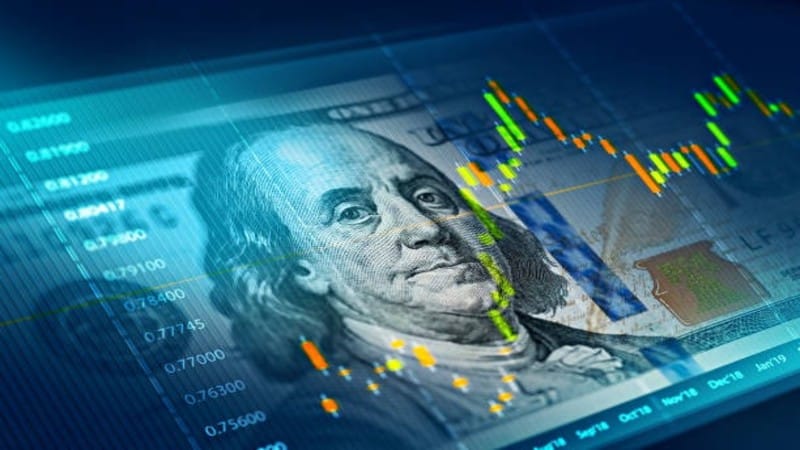
The U.S. dollar has strengthened again in global currency markets, with the Dollar Index (DXY) rising to 103 as investors move toward safer assets amid rising bond yields and global uncertainty. The renewed momentum highlights confidence in the U.S. economy, supported by firm labor data, resilient spending, and a central bank that remains cautious about cutting rates too soon. This upward move has pushed other major currencies lower, reaffirming the dollar’s dominant position in the world economy.
The dollar’s latest rally is not only about yield advantage but also about market sentiment. With Europe showing weaker growth, Japan struggling to stabilize the yen, and emerging economies facing capital outflows, the greenback has once again become the preferred safe haven. This shift is reshaping global trade flows, investment strategies, and monetary policy decisions as countries adjust to tighter financial conditions.
The rise of the dollar index and market dynamics
The Dollar Index, which measures the U.S. dollar against a basket of major currencies including the euro, yen, and pound, has been steadily climbing. Higher Treasury yields have played a key role in this move, as investors seek better returns from U.S. assets. The 10-year Treasury yield has remained comfortably above 4 percent, while shorter-term yields continue to signal that the Federal Reserve will maintain its restrictive stance into next year.
This divergence in interest rates has created an imbalance across major economies. While the European Central Bank and the Bank of Japan are either pausing or signaling potential policy easing, the U.S. Federal Reserve has maintained a firm tone on inflation and economic stability. The result is a widening yield gap that favors the dollar and attracts capital inflows into U.S. markets.
Large institutional traders have increased their long positions on the dollar in recent weeks, anticipating that its strength will persist through the first half of 2026. The dollar’s appeal lies not just in yield but in the relative stability of the U.S. economy, which continues to grow despite higher rates.
Inflation hedge and policy divergence
The dollar’s rise is also being driven by its long-standing role as a global inflation hedge. In an environment where price pressures remain unpredictable, investors prefer to hold assets tied to a strong and stable currency. The U.S. continues to offer positive real yields, meaning inflation-adjusted returns on bonds remain attractive compared to most developed markets.
At the same time, the divergence in central bank policies has deepened. The Federal Reserve’s cautious approach contrasts sharply with Europe’s softer tone and Japan’s accommodative stance. This difference in direction has widened yield spreads, encouraging investors to shift portfolios toward U.S. assets that combine safety with higher returns.
For corporations and hedge funds, this policy gap means rethinking currency exposure and funding strategies. Many global companies are hedging more aggressively against dollar appreciation, while investors in Europe and Asia are moving capital into short-term U.S. instruments for better yield and security.
Global currency weakness and capital flows
The dollar’s climb has come at the expense of other major currencies. The euro has fallen close to recent lows as Europe struggles with weak demand and an industrial slowdown. While a cheaper euro makes exports more competitive, it also raises import costs, particularly for energy. This has revived inflation concerns within the eurozone and placed additional pressure on the European Central Bank’s policy outlook.
In Japan, the yen continues to weaken despite verbal interventions from officials. The Bank of Japan’s gradual pace in adjusting its yield control policy has not been enough to stabilize the currency. Japanese investors are increasingly allocating funds abroad in search of better yields, adding further downward pressure on the yen.
The British pound has also faced renewed selling as the U.K. economy shows signs of stagnation. Elevated borrowing costs and persistent inflation have weakened consumer demand, while fiscal challenges limit the government’s ability to support growth. The dollar’s strength has only added to the pound’s struggles.
Emerging market currencies have been particularly vulnerable. The Indian rupee, Brazilian real, and South Korean won have all lost ground as global funds reduce exposure to higher-risk assets. A stronger dollar increases debt repayment burdens in countries with large dollar-denominated loans, leading to tighter credit conditions and slower growth.
Implications for trade and investment strategy
A stronger dollar reshapes global trade and investment in several ways. For U.S. exporters, it reduces competitiveness by making goods more expensive abroad. However, for American consumers and importers, it lowers prices for imported goods and helps contain inflation. This trade-off highlights how exchange rates can influence domestic inflation and growth simultaneously.
For multinational corporations, currency fluctuations are now a top concern. Many firms are expanding hedging programs and diversifying supply chains to manage the financial risks of a volatile dollar. Financial institutions are also adjusting portfolio allocations, shifting more capital into high-quality, dollar-denominated assets that provide both yield and liquidity.
Commodity markets have not been spared either. Oil, gold, and industrial metals often move inversely to the dollar. As the dollar strengthens, these commodities tend to decline in price, reducing revenues for exporting countries but providing relief to energy-importing nations. Investors in commodity-linked markets are watching the DXY closely as a signal of future price movements.
The global nature of the dollar’s dominance means that liquidity conditions in U.S. markets have far-reaching consequences. When the dollar strengthens, it often signals tighter financial conditions worldwide. Capital becomes more concentrated in U.S. markets, while funding costs for other economies increase. This ripple effect highlights the dollar’s power not just as a currency but as a global financial barometer.
Conclusion
The dollar’s climb to 103 on the DXY reflects more than a short-term trend. It underscores investor confidence in U.S. economic stability and reveals growing divergence among major economies. As yields remain high and liquidity tightens, the dollar is set to remain strong in the near term, shaping trade, capital flows, and policy decisions across the global economy.