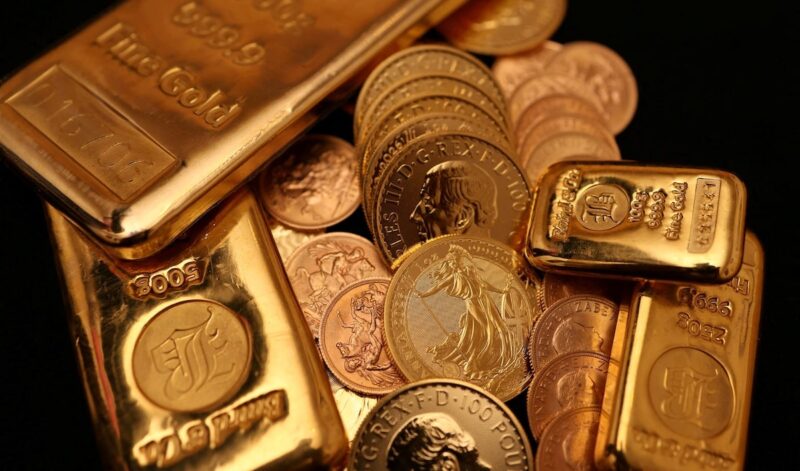
Gold’s explosive run in 2025 is reshaping how markets read risk, policy, and reserve strategy as prices hold near record territory going into year end. After climbing more than sixty percent this year and doubling over the past two years, bullion has moved into territory last seen during periods of extreme global stress. What makes the current cycle different is not just the magnitude of the move, but the breadth of buyers supporting it. Central banks, institutional investors, and new corporate participants have all added exposure, keeping prices elevated even after sharp gains. Rather than triggering widespread profit taking, the rally has reinforced gold’s role as a strategic asset in an environment defined by fiscal uncertainty, geopolitical tension, and shifting dollar dynamics. For markets tracking global signals, gold’s resilience is becoming a message in itself.
Demand from central banks has emerged as the anchor of this cycle, providing a steady bid whenever prices pull back. Reserve managers continue to diversify away from dollar heavy allocations, using gold as a neutral store of value amid concerns over deficits, trade disputes, and policy credibility. Analysts note that this steady accumulation has lifted the structural floor for prices, allowing gold to stabilize at levels that would once have seemed unsustainable. Investor positioning has also evolved, with gold now representing a larger share of total assets under management than before the pandemic era. That shift suggests the metal is no longer viewed solely as a crisis hedge, but as a core portfolio component. As a result, price corrections have been shallow, quickly met by renewed buying rather than prolonged selling pressure.
The broader market context adds another layer to gold’s signal value. Equities and gold rising together is a rare combination historically associated with deep uncertainty rather than pure optimism. Investors appear to be hedging exposure across asset classes, using gold to balance stretched valuations elsewhere. At the same time, expectations for continued central bank demand into 2026 are keeping longer term forecasts elevated, even as analysts warn that the pace of gains may slow. For currency and macro watchers, gold’s strength is closely tied to questions around dollar dominance and future policy paths. As 2025 closes, bullion is no longer just reflecting risk. It is actively shaping how markets price stability, confidence, and the direction of global reserves.