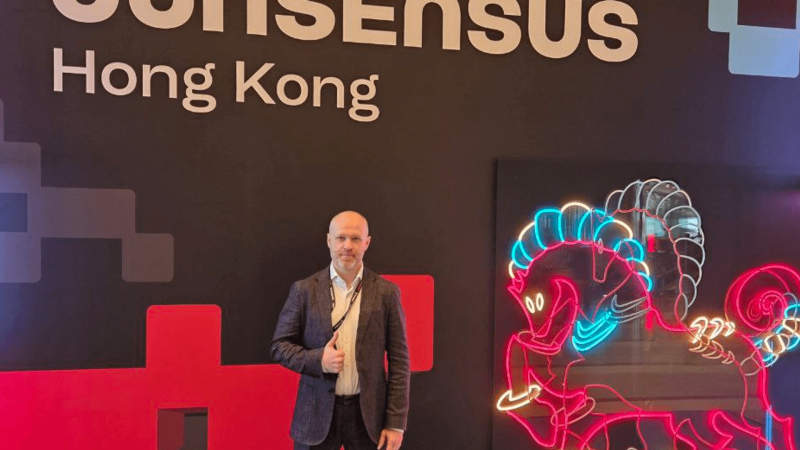
A ruble pegged stablecoin issuer operating under the shadow of United States sanctions is accelerating its global ambitions, positioning itself as a cross border payments rail for trade connected to Russia. Oleg Ogienko, the public representative of A7A5 and its director for regulatory and overseas affairs, says the company operates within the law of its home jurisdiction and adheres to international compliance standards even as affiliated entities face sanctions from the US Treasury.
A7A5 is incorporated in Kyrgyzstan and presents itself as a fully compliant digital asset issuer. According to Ogienko, the firm maintains know your customer procedures and anti money laundering systems embedded within its infrastructure. He argues that the company does not violate Financial Action Task Force principles and undergoes regular audits. From his perspective, sanctions imposed by Washington do not automatically translate into illegality in other jurisdictions where Russian trade remains active.
The complication lies in the structure behind the token. Issuing entities linked to A7A5, along with its reserve holding bank Promsvyazbank, are subject to US sanctions. That effectively blocks access to the dollar based financial system and deters many global exchanges from listing the token for fear of secondary sanctions. While the restrictions limit access to Western liquidity channels, they have also created a market niche. Businesses in Asia, Africa and South America that continue trading with Russian exporters are searching for alternative settlement mechanisms, and A7A5 is seeking to fill that gap.
The company reports rapid growth in circulating supply over the past year, outpacing more established dollar denominated stablecoins. Market data from digital asset analytics firms shows that ruble linked liquidity expanded sharply as cross border flows adapted to sanctions pressure. Ogienko frames the expansion not as a workaround for illegal activity but as a response to businesses needing payment continuity when traditional banking rails are constrained.
Liquidity remains a challenge. Major centralized exchanges have avoided listing the token, limiting broader market depth. On decentralized platforms, swaps into larger stablecoins such as USDT are technically possible, but available liquidity pools remain modest. To address this, A7A5 has been engaging blockchain platforms and exchanges across Asia in an effort to widen infrastructure support and increase token utility. The stablecoin is already deployed on networks including Tron and Ethereum, and the team is exploring additional integrations.
Industry events have illustrated the reputational sensitivity surrounding sanctioned affiliated entities. In some cases, partnerships and sponsorship references have been quietly removed amid concerns from other participants. Even so, Ogienko maintains that A7A5 is a commercial project rather than a political one, describing the firm as focused on trade facilitation rather than geopolitical positioning.
The broader question for markets is how stablecoin innovation intersects with sanctions regimes. As digital assets become embedded in global commerce, regulatory fragmentation is shaping new liquidity corridors outside the traditional dollar system. Whether A7A5 can achieve its stated ambition of settling a significant share of Russia related trade will depend not only on technology, but on how governments balance enforcement with the evolving architecture of cross border payments.