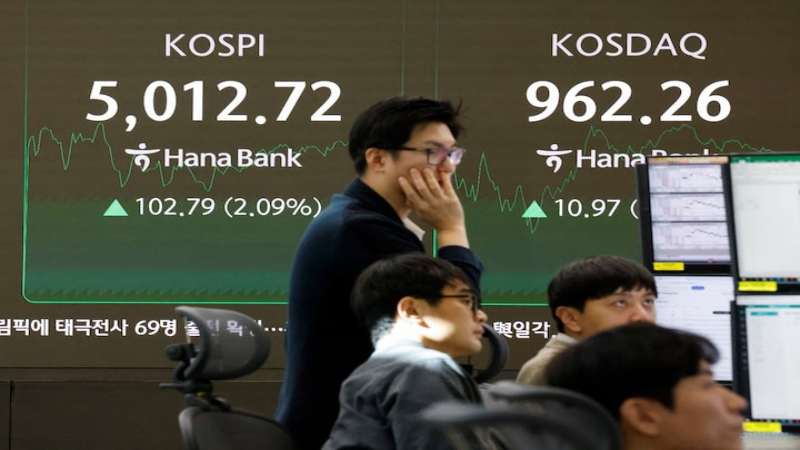
Emerging market equities have staged a powerful rally in early 2026, led by South Korea’s benchmark KOSPI index, which recently crossed the 5000 level for the first time. The surge has captured global attention and prompted investors to ask whether the pace of gains can realistically continue.
South Korean stocks have risen roughly 50 percent in just the first two months of the year, extending a remarkable run that began in 2025. Over the past six months, the KOSPI has doubled, and it has climbed dramatically from the lows recorded during last year’s tariff driven volatility. The index also posted strong gains throughout 2025, underscoring the persistence of the uptrend.
Technology shares have been central to the move. Samsung Electronics, a global leader in memory chips, has nearly doubled this year and more than tripled over six months. The semiconductor boom and accelerating demand linked to artificial intelligence applications have fueled earnings expectations. Market friendly tax and regulatory adjustments have also attracted international capital into the country.
The strength of the equity market has coincided with currency appreciation, with the Korean won reaching its strongest level against the dollar in several months. Financial conditions in South Korea have loosened significantly, reflecting rising asset prices and supportive liquidity dynamics.
Despite the speed of the rally, valuations suggest the move may not be purely speculative. The KOSPI is trading at relatively modest forward earnings multiples compared with its own history. Investors appear to be pricing in robust profit growth rather than chasing momentum alone.
South Korea is not an isolated case. Broader emerging market indices are also posting double digit gains this year. Taiwan and Brazil have delivered especially strong returns, benefiting from commodity resilience and their positions in the global technology supply chain. Taiwan Semiconductor Manufacturing plays a critical role in supplying advanced chips used in artificial intelligence systems developed by companies such as Nvidia and Apple.
Taiwan’s official growth forecast for 2026 was recently revised sharply higher, reflecting optimism around export demand and technology driven expansion. These upgrades reinforce the narrative that emerging economies, particularly in Asia, are capturing a greater share of the global AI value chain.
Investor positioning data supports this rotation. Recent global fund manager surveys show allocations to emerging market equities at their highest levels in several years, while exposure to U.S. stocks has declined. The reallocation suggests that investors view relative valuations and growth prospects in emerging markets as increasingly compelling.
However, periods of intense optimism can carry risks. Rapid inflows and crowded positioning raise the possibility of sharp pullbacks if earnings disappoint or global conditions shift. Much will depend on whether the AI driven growth cycle sustains momentum and whether the macro environment remains supportive, including stable bond markets and a manageable dollar trajectory.
For now, emerging markets continue to benefit from a combination of earnings optimism, structural technology themes and valuation appeal. Whether the rally cools or extends further will hinge on how durable these drivers prove in the months ahead.