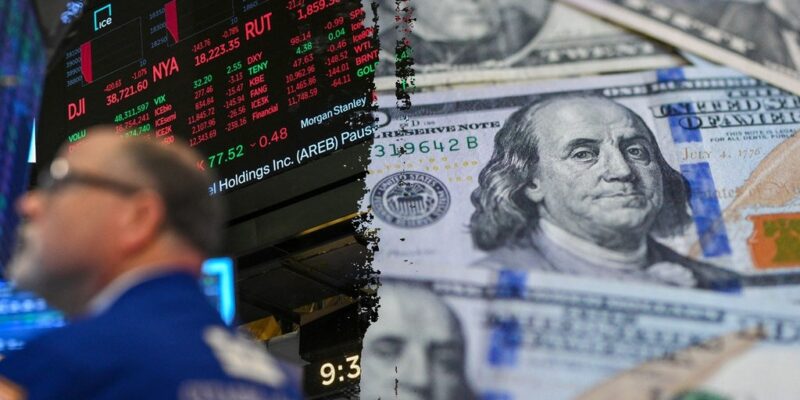
The U.S. dollar continued to lose ground this week as cooler inflation data and renewed trade tensions unsettled investors. The shift in market sentiment reflects a growing belief that the Federal Reserve may pivot toward easing policy sooner than expected.
For analysts, the dollar’s recent slide marks a pivotal moment. A currency that has dominated global markets for most of 2025 is now showing signs of fatigue as economic indicators soften and policy uncertainty deepens.
Inflation Signals Shift Market Expectations
The latest inflation report showed that U.S. consumer prices rose just 0.3 percent in September, undershooting expectations. Year-on-year inflation slowed to 3.1 percent, its lowest level in months. That outcome suggests the Fed’s efforts to curb inflation are working, but it also raises doubts about how long interest rates can remain restrictive.
Investors have quickly adjusted their outlook. Futures now price in a greater probability of a rate cut in early 2026, signaling a move away from the higher-for-longer stance that defined the first half of the year. Lower rate expectations have pushed Treasury yields down, weakening the dollar’s relative yield advantage against the euro, yen, and pound.
Still, policymakers are cautious. Several Fed officials emphasized that inflation remains above target, meaning any policy shift will depend on incoming data. Markets, however, appear convinced that the tightening cycle is nearing its end, and that perception alone has been enough to push the dollar index to multi-month lows.
Trade Tensions Weigh on Currency Strength
The economic narrative has been further complicated by renewed trade disputes. The latest round of U.S.–China tensions has sparked volatility across currency markets, with both nations introducing targeted restrictions on key exports. This rise in protectionist rhetoric has fueled investor anxiety over global supply chains and growth prospects.
When trade risks intensify, capital flows tend to fragment. Safe-haven demand no longer concentrates in the dollar alone, as investors seek alternatives such as the yen, Swiss franc, and gold. That diversification of risk is weighing on the greenback’s dominance in short-term currency flows.
For global businesses, trade uncertainty adds another layer of complexity to hedging strategies. Importers and exporters are revising currency exposure to protect margins against unpredictable policy headlines. The resulting volatility has widened daily ranges across major pairs, keeping traders on alert for sharp swings.
FX Volatility and Reserve Implications
The dollar index has fallen below a key support level as global markets reassess how sustainable its strength really is. Central banks holding large reserves are quietly reviewing exposure levels, considering gradual diversification into other major currencies and gold. While these adjustments are incremental, they signal a cautious shift in long-term strategy.
Emerging-market currencies have responded with mixed results. Nations with strong external balances, such as Brazil and India, have seen their currencies stabilize or strengthen. Others with weaker fundamentals continue to face pressure as capital flows remain selective and uneven.
Despite these fluctuations, the dollar remains the cornerstone of global reserves. Roughly 60 percent of central-bank holdings are still in U.S. assets. However, the tone has changed: the conversation is no longer whether diversification will happen, but how quickly it can be managed without disrupting global liquidity.
Outlook for Policy and Positioning
The dollar’s near-term direction now depends on the delicate interplay between inflation, monetary policy, and trade politics. If inflation continues to soften while the Fed maintains its cautious tone, markets could see a sustained period of range-bound trading rather than a dramatic selloff.
On the other hand, any surprise uptick in inflation or escalation in trade tensions could trigger another wave of volatility, quickly reversing the recent losses.
Institutional investors are adapting to this environment by shifting toward shorter duration exposures and more defensive positioning. Hedge funds and asset managers are using options strategies to manage risk, anticipating wider daily fluctuations in DXY and related currency baskets. This growing preference for flexibility highlights how uncertain the policy path has become.
Meanwhile, bond markets are reinforcing the trend. Yields on 10-year Treasuries have eased alongside the currency’s decline, reflecting bets that the U.S. economy is slowing but still resilient enough to avoid a hard landing. The result is a cautious optimism that may keep the dollar subdued without triggering a broader selloff.
Conclusion
The dollar’s recent weakness reflects a turning point in global markets. Softer inflation, shifting rate expectations, and mounting trade tensions are converging to redefine its short-term path. For investors and policymakers, this transition underscores how interdependent inflation, trade, and currency stability have become. Whether the dollar stabilizes or continues to drift lower will depend on the clarity of Fed policy and the outcome of global trade negotiations in the months ahead.