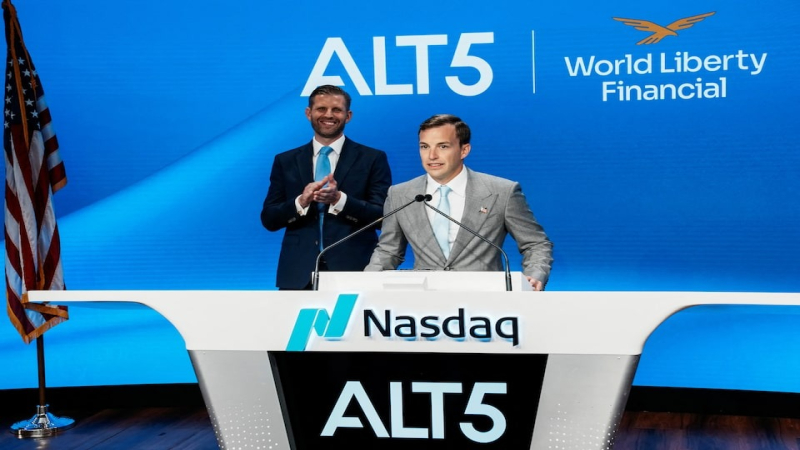
World Liberty Financial has triggered a fresh wave of excitement across the digital asset space after confirming the January rollout of its real world asset product suite during a major industry gathering in Dubai. The announcement instantly lit up crypto feeds because WLF’s push into tokenized assets is arriving at a moment when global markets are watching political shifts, regulatory recalibration and renewed interest in stablecoin backed strategies. One of the key talking points was the positioning of USD1, WLF’s stablecoin, which has already been used in high profile cross border transactions including the Abu Dhabi linked investment into Binance earlier this year. Traders framed the update as a signal that tokenization is moving from pilot stage into widescale commercialization, especially as heavyweight American political families become directly involved in digital finance strategies. With Dubai intensifying its role as a crypto hub, the timing of the rollout added even more energy to the event environment as industry leaders speculated on how far WLF intends to push its RWA ecosystem in early 2026.
The event unfolded against a backdrop of wider interest in asset tokenization, which many analysts describe as one of the next major unlocks in global financial infrastructure. While large institutions have experimented with tokenizing government debt, credit portfolios and supply chain assets, the acceleration of privately backed stablecoin companies entering the RWA field suggests another shift in the competitive map. WLF’s decision to align the official launch window with the start of the new quarter indicates a coordinated move to tap into January liquidity patterns where markets often reset risk positions and reassess exposure to alternative assets. Several panel discussions in Dubai referenced the demand coming from emerging markets seeking faster capital movement tools without friction from traditional settlement pipes. This created an atmosphere of anticipation as attendees monitored the reaction from whales, venture funds and corporate players who have been searching for new yield pathways in an increasingly crowded stablecoin environment.
Momentum around WLF also intersected with global political narratives that continue to influence digital finance flows. The involvement of prominent American family members added a layer of visibility that deepened market speculation about how much influence political networks could have on shaping tokenization standards. Industry observers commented that the rapid emergence of branded stablecoin strategies backed by high net worth groups reflects a new phase where financial identity and token strategy converge. With companies in the Gulf region accelerating adoption, WLF’s presence at a major Dubai event signaled a growing alignment between Middle Eastern crypto expansion and Western digital asset platforms. Analysts studying whale movements noted that the combination of political branding and real world asset infrastructure often attracts early speculative inflows, particularly from traders tracking large stablecoin supply shifts across exchanges. The coming January launch now sits at the center of one of the most anticipated RWA storylines of the new year as markets wait to see how aggressively WLF rolls out products and how other players respond to a clearly intensifying competition cycle.