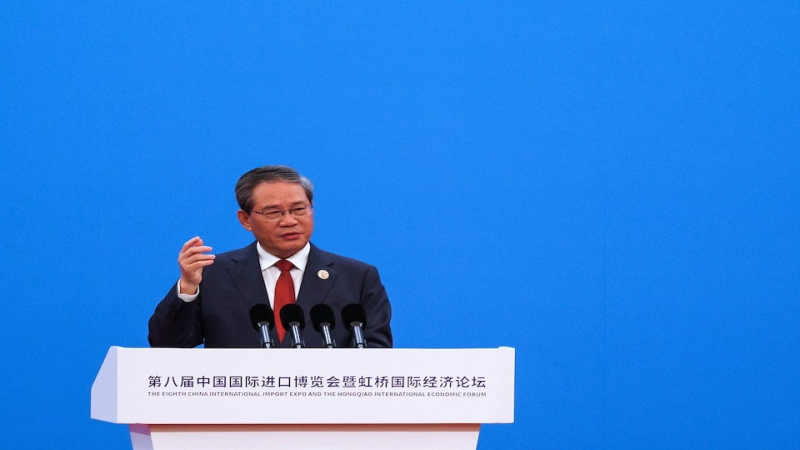
China’s Premier Li Qiang pledged to push for a fairer and more transparent global trading system while laying out growth ambitions that would lift China’s gross domestic product to roughly 170 trillion yuan by 2030, equal to about 23.8 trillion dollars at recent exchange rates. The remarks, delivered at a high profile economic forum in Beijing, framed China’s near term priorities as opening its markets further, improving the rules environment for foreign and domestic firms, and tightening alignment with international standards in trade and investment.
Li said policy will aim to support high quality development rather than short bursts of stimulus. The focus areas include advanced manufacturing, green energy, digital infrastructure, and targeted upgrades to critical supply chains. Officials see these sectors as capable of raising productivity, stabilizing employment, and lifting total factor efficiency, which Beijing views as essential as the labor force ages and potential growth moderates.
On external policy, Li called for renewed commitment to multilateral cooperation, arguing that predictable trade frameworks and transparent dispute settlement are necessary to restore confidence after years of pandemic disruption and rising protectionism. He urged greater voice for emerging economies in standard setting and emphasized that clearer market access rules would reduce friction along cross border supply routes in Asia and beyond. The message is designed to reassure global investors that China remains committed to pragmatic engagement even as geopolitical competition persists.
Domestically, the Premier acknowledged headwinds that continue to weigh on momentum, including uneven consumer sentiment and softer external demand. Policy guidance points to keeping macro settings supportive but disciplined, with targeted fiscal tools, liquidity conditions consistent with stable credit growth, and measures that aim to stabilize property related spillovers without fueling leverage. Officials also stress the importance of improving the business environment for private firms, including better access to financing and equal treatment in public procurement.
For global markets, the signals matter in three ways. First, a credible push for rule clarity could lower trade costs across regional manufacturing hubs, benefiting logistics, electronics, and clean tech supply chains. Second, commitments to green industry and digital infrastructure suggest ongoing demand for commodities tied to energy transition and for high end capital goods. Third, steady domestic rebalancing, if achieved, would support import demand for services and consumer oriented goods, a theme closely watched by exporters in Asia and Europe.
Investors will track policy follow through in licensing, data governance, and financial market access, which are practical tests of openness. They will also monitor local government financing conditions and the pace of structural reforms that lift productivity without rekindling macro imbalances. If implementation aligns with the stated agenda, China’s growth path toward 170 trillion yuan by 2030 would provide a sizable anchor for regional trade volumes and a moderating influence on global growth variability.
The overarching takeaway is that Beijing is pairing long term growth targets with an appeal for predictable global trade rules. For firms and markets, execution on domestic reforms and tangible steps on market access will determine how quickly sentiment translates into investment and cross border flows.