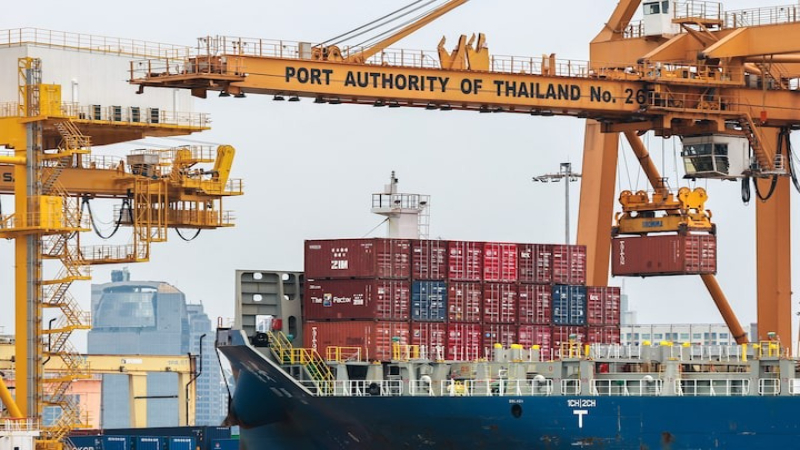
Thailand’s exports are projected to grow as much as 10.5 percent this year, a sharp improvement from earlier estimates of 2 to 3 percent, according to the Joint Standing Committee on Commerce, Industry and Banking (JSCCIB). The group credited higher shipments of gold and low-value goods for the improvement, but economists caution that the upturn may not meaningfully lift the country’s overall growth rate.
The JSCCIB maintained its forecast for 2025 GDP growth at 1.8 to 2.2 percent, estimating that stronger exports will contribute no more than 0.4 percent to economic output. Committee representative Phot Aramwattananon from the Thai Chamber of Commerce said the export increase, while welcome, remains concentrated in low-value categories that provide limited domestic benefit. He noted that additional stimulus through the government’s “co-payment” consumer-support program could help strengthen internal demand and offset weakness in local manufacturing.
Recent data from the Bank of Thailand show a mild recovery in industrial production and external trade. The Ministry of Finance has also upgraded its own projection for export growth to 10 percent, up from 5.5 percent earlier in the year. Officials attributed the revision to improved global logistics, easing supply-chain bottlenecks, and a rebound in select commodities such as gold and electronics.
Despite these positive signs, analysts say the expansion is heavily reliant on re-exported goods and temporary trade privileges. Lattakit Lapudomkarn, an economist at KKP Securities, explained that some Thai exporters are benefiting from “export rights” acquired from neighboring economies, which inflates trade volumes without increasing domestic manufacturing. He warned that the disconnect between rising exports and stagnant factory output signals that Thailand’s industrial base remains fragile.
The export upswing has supported the baht and temporarily improved the current-account balance, but structural weaknesses persist. High household debt, limited private investment, and slow wage growth continue to weigh on consumer confidence. Economists argue that without stronger domestic production and productivity reforms, Thailand risks depending too heavily on external demand that can reverse if global conditions soften.
Financial analysts in Bangkok emphasize that a stable export sector alone cannot sustain growth in an economy facing demographic headwinds and limited innovation. They urge policymakers to focus on long-term competitiveness through technology adoption, manufacturing incentives, and regional trade diversification.
In summary, Thailand’s impressive export surge underscores its resilience in global trade but also highlights enduring structural challenges. The near-term boost will help stabilize currency and fiscal flows, yet meaningful progress will depend on revitalizing industry and boosting internal demand.