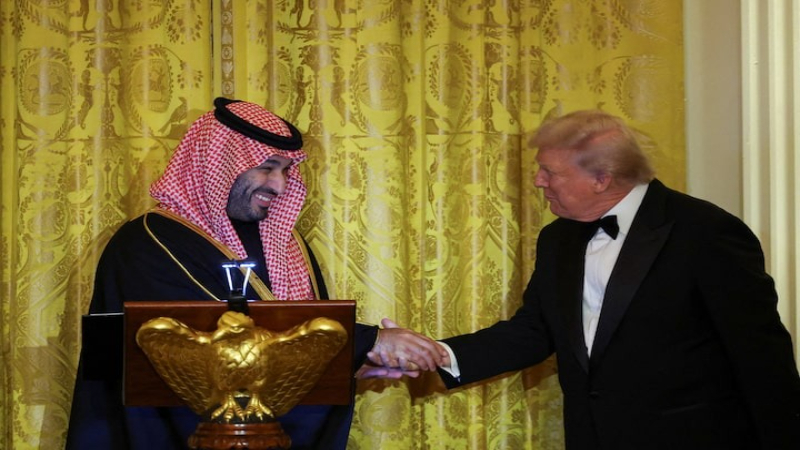
Washington’s investment scene lit up today as US and Saudi officials rolled out a wave of new business agreements tied to Crown Prince Mohammed bin Salman’s high profile visit, marking his first trip to the country since 2018. The energy in the room came from the scale of commitments being discussed, with US leaders touting more than two hundred seventy billion dollars in agreements across sectors ranging from energy to advanced technology. Corporate America showed up in force, with chief executives from Chevron, Qualcomm, Cisco, Boeing, Pfizer, Alphabet, Salesforce and several major investment firms taking part in the US Saudi Investment Forum. The gathering doubled as a showcase of deepening economic alignment between the two countries at a time when global capital is recalibrating toward AI infrastructure, defense modernization and high growth digital markets. The crown prince used the event to reaffirm plans to expand his country’s US investment footprint toward the trillion dollar mark, signaling that despite domestic megaproject costs, Saudi Arabia still views the US market as a strategic priority for long term positioning.
The conversations gained more intensity when President Trump outlined the scope of ongoing deals and emphasized the potential boost for US industry as major Saudi backed contracts move towards execution. Commerce officials described the new agreements as pathways for American companies to lead in innovation, safety and advanced deployment capabilities, especially in sectors where AI is expected to reshape economic power dynamics. At the White House the previous evening, Trump urged the crown prince to aim for an even larger investment commitment, a moment that underscored the administration’s push to solidify Saudi capital flows during a competitive global investment cycle. Analysts noted that the crown prince’s presence among top US executives also signals a strategic bid to reintroduce himself to Washington’s corporate ecosystem. The discussions between Tesla’s Elon Musk and Nvidia’s Jensen Huang highlighted the event’s future leaning narrative, with both executives predicting sweeping transformations in labor markets under accelerating AI adoption.
Behind the high profile signings are geopolitical and economic currents shaping how both countries plan to navigate the next decade. Saudi Arabia’s ambition to invest heavily in AI, energy and global logistics is constrained by domestic spending pressures tied to megacities, tourism expansions and World Cup commitments, raising questions about timelines for achieving a trillion dollar US investment footprint. Yet the forum’s turnout showed that many American firms still view the Gulf as an essential long term partner in energy diversification, data infrastructure and next generation industrial projects. Trump emphasized that his administration maintains distance from any private business relationships, framing the agreements as national strategic wins rather than personal benefit. The broader takeaway from the forum is that US Saudi economic ties are accelerating again, with AI, defense, energy transition and infrastructure forming a new backbone for partnership. Today’s event signaled that both countries see opportunity in aligning capital and innovation capacity during a period of global reshuffling.