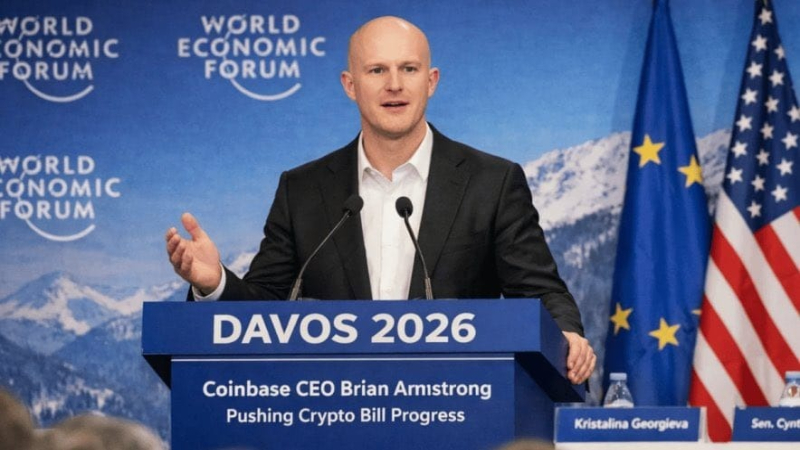
Discussions at the World Economic Forum in Davos signaled that tokenization has moved beyond theory into real-world financial experimentation, even as regulatory and market frictions remain unresolved. Policymakers, financial executives, and technology leaders treated tokenized money and assets as an emerging layer of global finance rather than a speculative trend. Conversations focused on how blockchain-based representations of money, deposits, and securities are already being tested for settlement efficiency, access, and transparency. At the same time, participants acknowledged that adoption is uneven, with liquidity constraints, fragmented rules, and cross-border inconsistencies limiting scale. The tone in Davos reflected cautious realism, emphasizing that tokenization’s future depends less on technical feasibility and more on whether institutions and regulators can align frameworks that support trust and interoperability across markets.
Regulatory uncertainty featured prominently, particularly around the United States approach to tokenized assets. Recent guidance from U.S. authorities clarified how existing securities laws may apply to tokenized instruments, but left open questions around tokenized deposits and other hybrid models that fall between regulatory mandates. Market participants highlighted that overlapping oversight and stalled legislative efforts continue to slow institutional participation. Without a unified market structure, firms face higher compliance costs and legal ambiguity, reducing incentives to deploy capital at scale. The absence of comprehensive rules was repeatedly framed as a competitive risk, as jurisdictions with clearer frameworks are moving faster to attract investment, infrastructure providers, and cross-border pilots tied to digital settlement and asset issuance.
In contrast, several emerging and non-Western markets presented tokenization as a practical solution to long-standing financial inefficiencies. Countries across Latin America, Africa, and the Middle East showcased initiatives aimed at expanding market access and reducing friction in payments and capital markets. Stablecoins and tokenized instruments were described as tools for shortening settlement times, lowering transaction costs, and enabling participation from users historically excluded from traditional systems. Speakers emphasized that adoption gains traction when digital assets address everyday economic problems rather than abstract innovation goals. Retail relevance, regulatory clarity, and integration with existing financial rails were cited as decisive factors in whether tokenized products can scale beyond pilot programs.
The broader message from Davos was that tokenization is increasingly viewed as an inevitability, but not a guaranteed success. Participants stressed that value creation hinges on coordination between regulators, banks, and technology providers, especially as global finance becomes more digitally interconnected. For advanced economies, the challenge lies in modernizing rules without fragmenting markets, while for developing regions the focus remains on leveraging digital finance to accelerate inclusion and growth. As tokenized money and assets continue to mature, the gap between jurisdictions with clear policy direction and those without is likely to widen, shaping where capital, innovation, and liquidity ultimately concentrate.